

If you’re a parent of a teenager, you’ve probably wondered: “Am I pushing too much, or am I not guiding enough?”
It’s a familiar tension. You want your child to have security and opportunity, but you also don’t want them stuck in something they’ll resent ten years down the line. And with classes 8 to 12 being decision-heavy streams, coaching, and college prep, it can feel like the future is hurtling toward you faster than expected.
But here’s something many parents miss: career choices aren’t just about marks, popular courses, or “safe” professions. They’re about the strengths, interests, and motivations your child naturally carries. Some of these are easy to see; others need the right questions to surface.
Let’s explore ten questions that can help you understand your teen better and guide them toward a career plan that actually fits who they are.
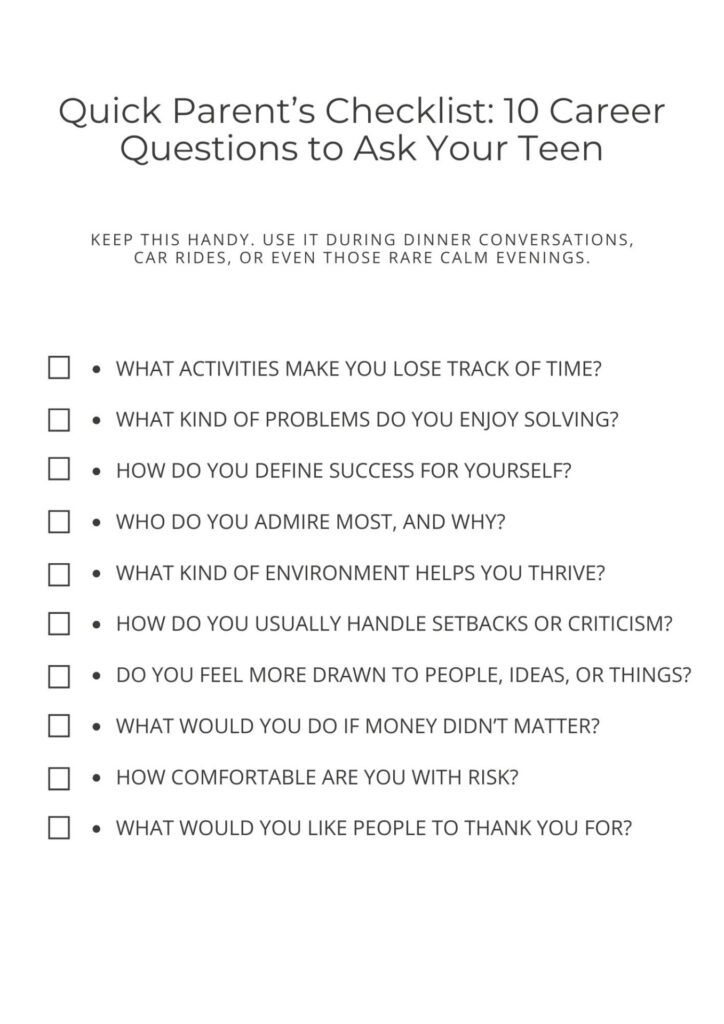
1. What activities make you forget about time?

Every parent has seen their child so absorbed in something that lunch, chores, and even Instagram notifications don’t exist for a while. That state of deep engagement often points to natural strengths at work.
It could be your son fiddling with robotics kits for hours. Or your daughter leading her friends in planning a school event. These moments are clues. They reveal what energizes your child, not just what they’re “good” at academically.
2. What kind of problems excite you?
Most jobs boil down to solving problems. Doctors solve health puzzles. Coders fix bugs. Teachers untangle learning gaps.
So instead of asking, “Which career do you want?” a question that often freezes teenagers, ask, “What kind of problems do you enjoy tackling?” Some kids enjoy fixing gadgets, while others excel at resolving disputes. These preferences aren’t random. They’re early signs of their strengths in action.
3. How do you define success for yourself?
Parents often equate success with stability, income, or reputation. Teenagers may see it differently, freedom to travel, a sense of impact, or simply waking up excited for work.
It may sound dreamy, even unrealistic. However, their definition of success reveals what values matter most to them. Pair that with their natural strengths, and you start to see career paths that balance practicality with meaning.
4. Who do you look up to and why?
Role models say more than they seem. A teenager who admires a cricketer may be responding to discipline and resilience, not just the sport. Someone obsessed with a YouTuber might actually admire creativity, storytelling, or consistency.
The “why” behind admiration reveals underlying strengths and values. This is where you begin to see patterns, whether they’re drawn to innovation, leadership, or empathy.
5. What kind of environment do you thrive in?

Some children thrive in structured environments, with clear rules, predictability, and defined pathways. Others need flexibility, open-ended projects, and room to experiment.
This isn’t about ability; it’s about natural wiring. A cactus and a lotus both thrive, but in very different conditions. When you match a child’s strengths to the right environment, growth feels natural instead of forced.
6. How do you handle setbacks or criticism?
Careers, like Indian roads, aren’t without bumps and unexpected turns. Some kids bounce back quickly, enjoying the challenge. Others need reassurance and collaboration to keep moving forward.
Neither is “better.” It’s about recognizing what strengths they lean on when things get tough. Do they use creativity to solve problems? Do they rely on empathy to seek support? These responses guide you toward careers that fit not just their skills, but their coping style.
7. Do you prefer working with people, ideas, or things?
This deceptively simple question helps uncover preferences:
- People-oriented: counseling, leadership, customer engagement, teaching
- Idea-oriented: writing, research, coding, strategic planning
- Thing-oriented: design, architecture, engineering, lab sciences
Sure, many careers blend all three. But understanding where your child’s energy flows most naturally gives you a clearer picture of where their strengths might shine brightest.
8. What would you do if money weren’t a concern?
It’s a classic question, but still useful. Stripping away financial pressure allows your child to dream openly.
Even if the answer sounds unrealistic, “I’d travel the world making videos,” don’t dismiss it. Look for the underlying themes. Is it storytelling? Creativity? Adventure? Those patterns often overlap with natural strengths that can be built into a career.
9. How do you feel about risk?
Risk isn’t everyone’s cup of tea. Some children are naturally drawn to the thrill of uncertainty, entrepreneurship, creative fields, and startups. Others feel most confident with predictable teaching, banking, and civil services.
Neither is wrong. Knowing how your child relates to risk ensures you’re not pushing them into environments that clash with their strengths.
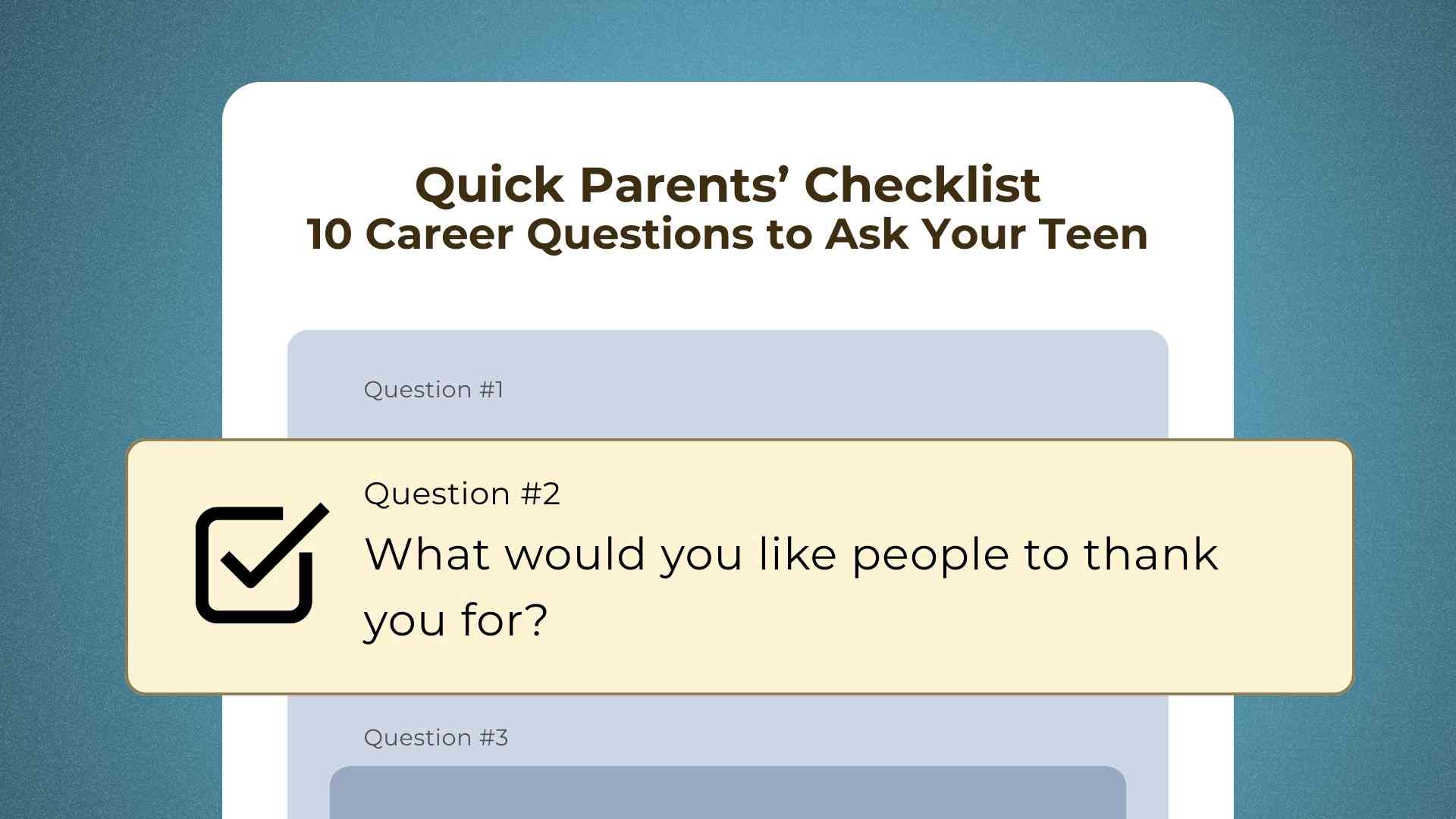
10. What would you like people to thank you for?
It may sound unusual, but it’s powerful. Do they want to be thanked for solving problems? For inspiring others? For making people feel safe? For creating something new?
This question points to deeper motivations. And when motivations meet strengths, career decisions become less about pressure and more about purpose.
Why Strengths Matter in Career Planning
Here’s the thing: these questions are valuable, but they work best when you’re not just guessing. Observations can be subjective, and as parents, we often see what we want to see.
That’s why strengths-based career planning is so powerful. At Strengths Masters, we help students discover their natural strengths and then develop career plans centered on those strengths. It’s not about forcing them into boxes or fixing weaknesses. It’s about amplifying what’s already strong so that choices feel both practical and authentic.
A Gentle Reminder for Parents
Your child’s answers may change over time. One year it’s astrophysics, next year it’s graphic design. That’s okay. Identity in adolescence is fluid, and forcing early commitments usually backfires.
The best you can do is stay curious, ask questions, and gently guide them to see how their natural strengths can shape a future that’s both meaningful and sustainable.
Final Thought
So, the next time your teenager feels lost or overwhelmed, resist the urge to prescribe a “safe” career path. Instead, sit down, maybe over chai, maybe on a quiet car ride, and ask one of these ten questions.
Because sometimes, the right question doesn’t just guide a decision. It opens a window into your child’s strengths, and shows them (and you) what’s possible when a career is built around who they truly are.